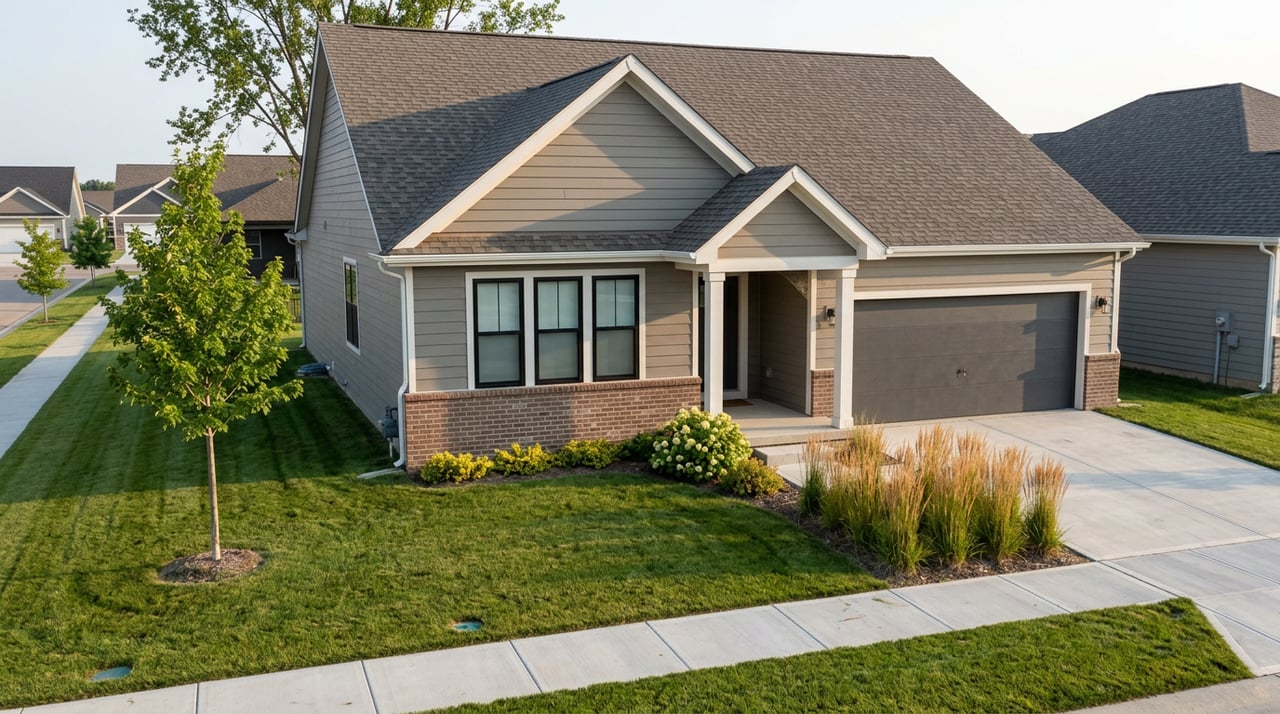
Ashwaubenon Home Prices Are Outpacing Wisconsin. Here's What That Number Is Actually Measuring
August 27, 2026
August 27, 2026
"We are really trying to reinvent ourselves from your classic, first-ring suburb," Ashwaubenon's community development director Aaron Schuette told a local TV reporter last year, describing a village that used to be known for strip malls and is now building apartments next to a minor-league ballpark and townhomes next to a distillery. He wasn't talking about home values when he said it. But it's the sentence that explains them.
As of June 2026, Redfin's state comparison data put Ashwaubenon's year-over-year home price growth at 19.3 percent, the sixth-fastest appreciation rate of any city tracked in Wisconsin that month, well ahead of the statewide average of 5.6 percent. If you're cross-shopping Ashwaubenon against Bellevue, Howard, or De Pere, that's the kind of number that either excites you or scares you off, depending on which side of the closing table you expect to sit on. It shouldn't do either, at least not yet. Read on its own, it tells you almost nothing about what a typical existing home in Ashwaubenon is worth today. It tells you something more specific and, for a buyer or seller trying to price a house correctly, more useful: the village is actively changing what gets sold there, and the number is measuring that change more than it's measuring demand for the homes that were already standing.
Ashwaubenon doesn't sell a lot of homes in any given month, and that matters more than most market write-ups admit. Redfin's own snapshot from September 2024 recorded just 13 homes sold in the village that month, a sample small enough that a handful of higher-priced closings can swing the year-over-year figure dramatically. That same month, Ashwaubenon's reported price growth hit 64.3 percent year over year, a number nobody would mistake for organic appreciation once you know the sample size behind it.
That's not a criticism of the data. It's the nature of tracking a village-sized market instead of a metro-sized one. But it's the reason a healthy amount of skepticism belongs in front of any single-month or single-year appreciation figure for Ashwaubenon, including the 19.3 percent reading from this June. The question worth asking isn't whether the number is accurate. It's what's actually inside it.
Over the past two years, Ashwaubenon's Village Board has approved a run of projects that add exactly the kind of higher-priced inventory that would pull a small market's median upward, independent of what's happening to the value of the ranch homes and split-levels that make up most of the village's existing housing stock.
None of that is speculative. Every one of those projects cleared village approval and shows up in board records and local news coverage from 2024 and 2025. And all of it lands in the same small sales pool that produced a 19-percent headline number. When a village that used to sell modest, decades-old homes starts also selling $450,000 to $650,000 new construction alongside luxury riverfront apartments, the median doesn't need broad-based demand to move. It just needs the mix to shift.
There's a smaller, almost incidental data point that makes the same case from a different angle. In February 2026, Brown County listed its former Ashwaubenon library branch, at 1060 Orlando Drive, for sale at $695,000, marketing the 8,000-square-foot building partly on the strength of being five blocks from Lambeau Field. A public building that's no longer needed for its original purpose, priced on proximity to the stadium district rather than on its function, is a small but telling sign of how much of Ashwaubenon's current pricing conversation runs through geography near Titletown rather than through the housing stock as a whole.
Ashwaubenon wasn't alone at the top of Wisconsin's appreciation list in June 2026. The cities ahead of it and just behind it tell a consistent story.
| City | YoY price growth (June 2026) |
|---|---|
| Caledonia | 39.4% |
| Port Washington | 26.3% |
| Wausau | 23.3% |
| Mequon | 22.1% |
| Kenosha | 21.7% |
| Ashwaubenon | 19.3% |
| Beloit | 19.1% |
| Hudson | 18.1% |
Wisconsin's statewide figure that month sat at 5.6 percent. Every city on this list is a smaller or mid-sized market undergoing some form of visible reinvestment, new construction, or commercial redevelopment rather than a large metro absorbing broad-based buyer demand across thousands of monthly transactions. Ashwaubenon fits that pattern exactly. It isn't an anomaly. It's a village-sized market where a construction pipeline is doing what construction pipelines do to a median in a small sample.
If you're a buyer using Ashwaubenon's appreciation rate as a proxy for how much a specific existing home has gained in value, you're likely overestimating it. The homes driving the average up are largely new construction in a handful of developments, priced at a level the village's older housing stock doesn't automatically follow just because they share a zip code. An older three-bedroom ranch near Cormier Road hasn't necessarily appreciated 19 percent this year. It may have appreciated far less, which for a buyer comparing move-up options against Bellevue or Howard could mean Ashwaubenon's existing stock is a better relative value than the headline number suggests.
If you're a seller with an older home, the opposite caution applies. Comparable sales in your immediate area may now include new-construction listings priced well above what your home, however well maintained, is likely to command. Pricing a listing off those comps without adjusting for age, finishes, and lot size is one of the more common ways sellers in a rapidly redeveloping village overprice and then sit on the market longer than they expected.
And if proximity to Titletown, Lambeau Field, or the growing Holmgren Way corridor is part of what's drawing you to Ashwaubenon in the first place, that premium is real and it's concentrated. It shows up in the new-construction pricing, in projects like Manseau Flats, and even in how the county priced its old library building. It's not spread evenly across the village, and treating it as if it were is where a buyer's math tends to go wrong.
None of this means Ashwaubenon's market isn't strong. The village is clearly attracting new development dollars and reshaping itself in ways that will likely support values over time, particularly close to the entertainment district. But a 19.3 percent year-over-year figure built on a thin sales sample and a construction boom tells a buyer or seller something different from what the same figure would mean in a market moving thousands of homes a month. Understanding which story you're actually reading is the difference between pricing a house correctly and guessing.
If you're weighing Ashwaubenon against another Green Bay-area suburb, or trying to figure out what a specific home there is actually worth in this market, Becky Buckland can walk through the comps that matter for your situation, not just the headline number. Request a personalized consultation and get a read on the market that accounts for what's actually driving it.
Stay up to date on the latest real estate trends.
Whether you’re ready to buy, sell, or invest, Becky Buckland Real Estate Collaborative is here to make the process smooth and successful. Put our local expertise and dedication to work for you.